Which water should you put in a steam generator iron?
Tap water, demineralised water, filter-jug water, softened water: each has its advantages and its pitfalls. Here is what you need to know to protect your steam generator from limescale without damaging it, and what the manual says, which always comes first.
Contents
The golden rule: the manual
Not all steam generators react the same way to the water you give them. Circuits, materials and anti-scale systems differ from one manufacturer to another, and sometimes between models. So the first rule is simple: follow your appliance’s manual. It tells you which water to use, sometimes depending on your water hardness, and which waters to avoid.
This guide sets out the general principles behind those recommendations. It complements our cornerstone guide on how to descale a steam generator iron.
Tap water
It is the most practical option, and many recent steam generators are designed to take it, as long as you keep up with descaling. Its only drawback is limescale, which varies a great deal from area to area.
Advantages
- Always available and almost free
- Fill straight from the tap with a removable tank
- Its mineral content helps steady steam production
Drawbacks
- Limescale, all the more so in hard water areas
- More frequent descaling with hard water
If your manual allows tap water, use it and descale at the recommended intervals. In very hard water areas, some manuals recommend mixing it with demineralised water.
Demineralised or distilled water
Sold in bottles at supermarkets, DIY stores and motor shops, it contains almost no minerals, so it all but removes the limescale problem. That does not make it the best choice every time.
- Some manufacturers advise against using it on its own: water with no minerals at all can upset steam production on certain models and lead to spitting.
- Others allow or recommend it, especially in very hard water areas.
- It costs money and has to be stored.
Do not confuse demineralised water sold for appliances with condensation water from a tumble dryer or air conditioner: that contains detergent residue, fibres and dust, and must not be used.
Mixing tap and demineralised water
Many manuals suggest, in hard water areas, mixing tap water and demineralised water, often half and half. That cuts limescale while keeping a little mineral content. Stick to the ratio your manual gives: it depends on how the appliance is designed.
Filter-jug water
Filter jugs hold back some of the limescale thanks to their resin. The water is softer, which slows scale build-up. Some manuals allow it; others do not mention it. If you use one, change the cartridge on time: a spent cartridge no longer filters, and some can release small particles.
Softened water
A home water softener replaces calcium and magnesium with sodium through ion exchange. The water no longer forms limescale, but it contains more dissolved salts. Several makers of steam appliances advise against it, because it can encourage spitting or other deposits. Check the manual before using it. Many homes with a softener keep one unsoftened tap in the kitchen, which is usually the one to fill the tank from.
Bottled water
Mineral or spring water is not necessarily softer than tap water: some are heavily mineralised. Read the label, which gives the calcium and magnesium content. A low-mineral water may be fine if the manual allows it, but it is expensive for regular use.
Waters and additives to avoid
Never pour into a steam generator: tumble dryer or air conditioner water, unfiltered rainwater, perfume or scented linen water, starch, fabric conditioner, vinegar or any descaler not specified in the manual, boiled water concentrated with scale. These liquids can damage the appliance, stain laundry or cause spitting.
To scent your laundry, use fabric conditioner in the wash or a scented sachet in the wardrobe, never the steam generator’s tank.
Summary table
| Type of water | Effect on limescale | Points to watch |
|---|---|---|
| Tap, soft water | Low | None, empty the tank when not in use |
| Tap, hard water | High | Frequent descaling or a mix, as per the manual |
| Filter jug | Reduced | Change the cartridge, check the manual allows it |
| Softened | Very low | Often advised against by manufacturers |
| Pure demineralised | Almost none | Sometimes advised against on its own |
| Tap and demineralised mix | Reduced | Ratio as per the manual |
| Bottled | Varies | Read the mineral content, cost |
| Tumble dryer, rain | Residues | Avoid |
Depending on where you live
Water hardness varies widely across the UK depending on geology. Much of the south and east of England, including London, has hard water, while large parts of Scotland, Wales, Northern Ireland and the north-west of England have softer water. It can even differ between neighbouring towns depending on where the supply comes from. The reliable way to find out is to check your water supplier’s website, where you can usually search by postcode.
| Your water | General advice |
|---|---|
| Soft (under 150 mg/l calcium carbonate) | Tap water if the manual allows, less frequent descaling |
| Medium (150 to 300 mg/l) | Tap water and regular descaling |
| Hard (over 300 mg/l) | Mix with demineralised water if the manual says so, frequent descaling |
Hardness units explained
Water companies, manuals and test strips do not always use the same unit, which is a common source of confusion. These equivalents let you convert between them.
| Unit | Equivalent | Where you will see it |
|---|---|---|
| mg/l calcium carbonate | The most common UK unit | Water supplier websites |
| 1 Clark degree (°e) | About 14.3 mg/l calcium carbonate | Some UK suppliers and older appliances |
| 1 French degree (°f) | 10 mg/l calcium carbonate | European appliance manuals |
| 1 German degree (°dH) | About 17.8 mg/l calcium carbonate | Test strips, dishwashers |
Because the PSG6064/80 is a European model, its manual may refer to French or German degrees. To compare with your supplier’s figure in mg/l, divide by ten for French degrees or by about 17.8 for German degrees.
The PerfectCare 6000
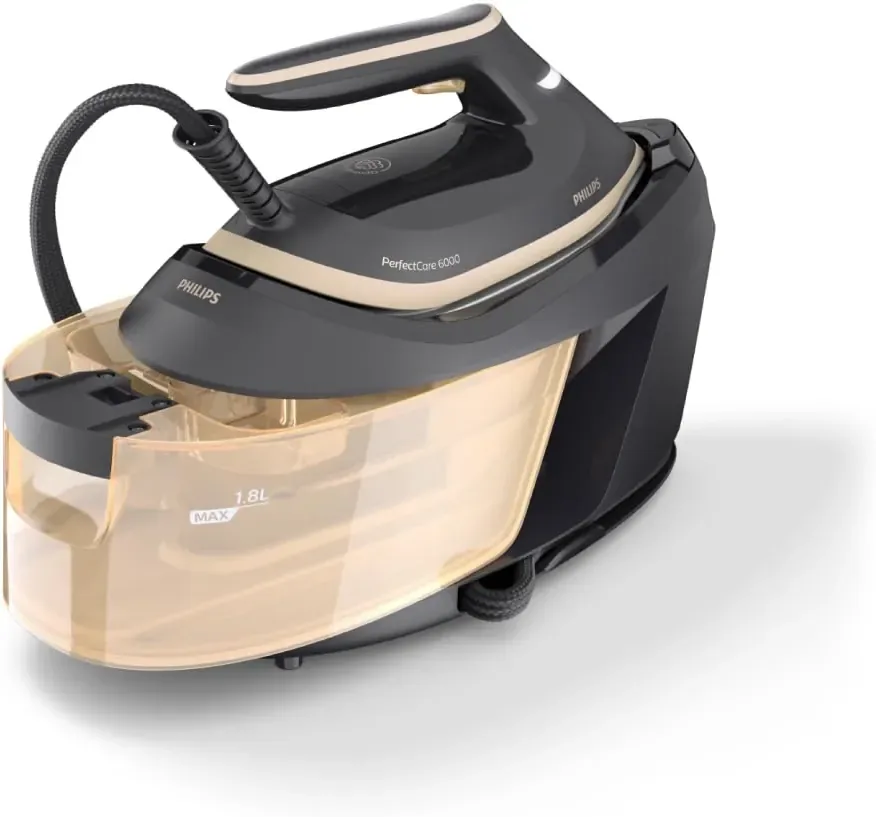
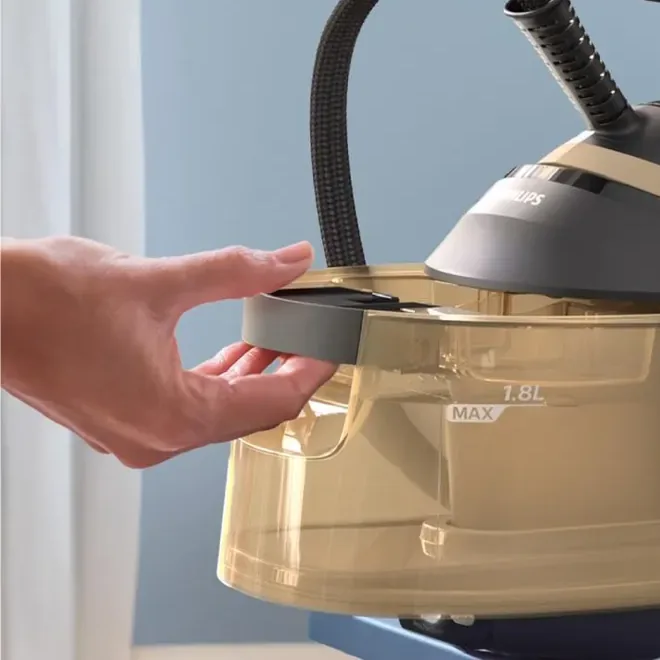
For the Philips PerfectCare 6000 PSG6064/80, Philips documentation states that the appliance is suitable for tap water. Limescale is handled by the Smart Calc Clean system: a light and a beep remind you to descale, which you do with the iron standing on the supplied container. The removable 1.8 L tank fills straight from the tap, at any time.
In very hard water areas, follow the recommendations in your appliance’s manual, which may specify a mix. Either way, empty the tank if you will not be ironing for several days. Our full review explains how the appliance works.
On holiday or away from home
If you take your steam generator to a second home or a holiday let, find out about the local water hardness: a few weeks of very hard water can speed up scale build-up. When you get back, rinse the tank and run the appliance with your usual water. For short trips, a handheld steamer is still more practical than a steam generator.
One last useful habit: whenever you change water, whether after a move or when switching from tap water to a mix, keep an eye on how the appliance behaves over the first few sessions. Wetter steam, spitting or more frequent descaling reminders are all clues that you need to adjust your routine. Make a note of what you see: it will help you find the right balance for your water.
What tap water really contains
Tap water is not pure water: it carries dissolved minerals that vary with the source, whether groundwater, river or reservoir. For a steam generator, two groups matter. Calcium and magnesium form limescale when heated; they are what hardness measures. Other salts, such as sodium or sulphates, stay dissolved and concentrate slightly in the circuit, without normally forming hard deposits.
The chlorine added for disinfection causes no particular problem for steam generators at the levels found in tap water. Cloudiness, the fine particles that sometimes appear after work on the mains, can block small holes: if the water runs cloudy, let it run for a moment before filling the tank.
Understanding this makes manufacturers’ advice easier to follow: the aim is to limit calcium and magnesium without removing all the minerals, which some appliances rely on for steady steam.
Testing your water hardness yourself
If you cannot find the information from your supplier, a home test gives a good idea:
- Get some test strips for water hardness, sold in DIY stores and aquarium shops, or supplied with some dishwashers.
- Run the cold tap for a few seconds, then fill a clean glass.
- Dip the strip for the time stated, usually one second.
- Compare the colour with the chart on the box after the set time.
- Convert if necessary: strips are often graduated in German degrees; 1 German degree is about 17.8 mg/l calcium carbonate.
The result is approximate but enough to classify your water as soft, medium or hard and choose the right maintenance routine.
The cost of each option
Tap water costs a fraction of a penny per tank. Bottled demineralised water is noticeably more expensive over time, especially for a 1.8 L tank filled every week. A filter jug means buying cartridges regularly. A home water softener is a big investment that cannot be justified by a steam generator alone.
For most households, the cheapest and simplest solution remains tap water combined with regular descaling, where the manual allows it. Mixing with demineralised water is for very hard water or for manuals that ask for it.
A simple water routine
- Fill just before ironing, with fresh water, rather than leaving the tank full between sessions.
- Empty what is left if the next session is more than a few days away.
- Keep a bottle of demineralised water next to the steam generator if your manual recommends a mix, so you do not forget.
- Note the date of each descale to find the right rhythm.
- Watch the laundry: white specks are the first sign that the water or the maintenance needs adjusting.
These habits take a few seconds and noticeably extend how long the appliance keeps performing well, whatever water you choose.
Myths about steam generator water
- “Demineralised water is always best.” Not for every model: some manufacturers advise against using it on its own.
- “Boiled water makes less scale.” Boiling makes some scale settle in the kettle, but the water can then carry particles, and it achieves little.
- “Rainwater is naturally soft.” It often is, but it contains dust and impurities: avoid it without proper filtering.
- “Scented water perfumes the laundry.” Perfumes damage the circuit and can stain: scent your laundry another way.
- “With a filter jug you never need to descale.” Scale is reduced, not eliminated: descaling is still needed, just less often.
Signs your water is not right
- White specks on the laundry after a few weeks: the water is hard and you need to descale more often.
- Spitting with very low-mineral water: some appliances do not make steam well from fully demineralised water.
- Brown marks: residue in the circuit, sometimes due to unsuitable water or additives.
- A smell when the steam comes out: stale water in the tank.
- Very frequent descaling reminders: hard water, consider a mix if the manual allows.
In any of these cases, go back to the manual, adjust the water and maintenance, and test on a cloth before ironing your laundry.
Choosing in three questions
- What does my manual say? That answer trumps everything else.
- How hard is my water? Soft: stick with tap water. Hard: consider a mix if the manual allows it.
- How much maintenance am I willing to do? With guided descaling and a reminder, tap water is often the simplest solution.
Those three questions are enough in the vast majority of cases, without buying bottled water or extra equipment.
Finally, bear in mind that perfect water does not exist: every option is a trade-off between simplicity, cost and protection against limescale. With a steam generator that accepts tap water and offers guided descaling, the most effective approach is to follow the manual and respond to the reminders, rather than juggling different waters and products.
Frequently asked questions
Can you put tap water in a steam generator iron?
Often yes, if the manual allows it, as with the PerfectCare 6000 according to Philips. Descale at the recommended intervals, more often in hard water areas.
Is demineralised water better?
It almost eliminates limescale, but some manufacturers advise against using it on its own. In hard water areas, a mix with tap water is often recommended.
Can you use water from a tumble dryer?
No. It contains detergent residue and fibres that can stain laundry and damage the appliance.
Can you scent the water in a steam generator?
No. Perfumes and additives can damage the circuit and stain laundry. Scent your laundry in the wash or in the wardrobe.
Is softened water suitable?
Steam appliance manufacturers often advise against it. Check your manual.
How do I find out my water hardness?
On your water supplier’s website, usually by postcode, on your water bill or with test strips.
Crisp laundry, in less time.
8 bar · 150 g/min · 600 g steam boost · 2400 W · 1.8 L tank. The price changes often on Amazon: check it, along with the seller, the PSG6064/80 model number, the UK plug and the returns policy, before you order.
Check the price on AmazonAffiliate link · new tab