How to descale a steam generator iron: the complete guide
Limescale is the number one enemy of steam generators: it cuts steam output, stains laundry and eventually blocks the appliance. The good news is that a few simple habits and regular descaling are enough. Here is how to do it for your type of model, without damaging your steam generator.
Contents
In short:
- Limescale reduces steam output, causes spitting and stains, and eventually blocks the appliance.
- Know your water hardness: it sets the descaling rhythm.
- Follow the reminder on your steam generator if it has one, and the method in the manual.
- Never use a product the manual does not allow.
- Empty the tank if the appliance will not be used for several days.
Why limescale is enemy number one
Tap water contains dissolved minerals, mainly calcium and magnesium. When it is heated and turned to steam, some of those minerals come out of solution and settle as limescale. In a steam generator, hundreds of millilitres of water are turned to steam in a narrow circuit every session: limescale builds up session after session.
The effects come on gradually. The deposit insulates the heating element, which heats less well. It narrows the channels and steam holes, which cuts output. Particles break off and come out through the soleplate, leaving white or brownish marks on laundry. Eventually the appliance blocks up or breaks down.
That is why durability tests in consumer laboratories track steam output over time: limescale is the main enemy of steam appliances.
Limescale in two minutes
Water that passes through chalk and limestone picks up calcium ions, magnesium ions and bicarbonates. While it is cold, these stay dissolved. When it is heated, the bicarbonates release carbon dioxide and the calcium forms calcium carbonate, which does not dissolve and settles on the hottest surfaces.
The harder the water and the more of it is turned to steam, the faster deposits form. A steam generator combines both: it turns all the water it uses into steam, concentrating every mineral in its circuit. That is why an effective, simple anti-scale system matters as much as performance.
Know your water hardness
In the UK, water hardness is usually given in milligrams of calcium carbonate per litre (mg/l), sometimes in Clark degrees, where 1 Clark degree is about 14.3 mg/l. A common rough guide:
| Hardness | Guide value | What it means for a steam generator |
|---|---|---|
| Soft water | Under 150 mg/l | Little limescale, light maintenance |
| Moderately hard water | 150 to 300 mg/l | Regular limescale, plan to descale |
| Hard water | Over 300 mg/l | Rapid limescale, frequent descaling |
To find out your water hardness:
- check your water supplier’s website, which usually lets you search by postcode;
- look at your water bill or contact your supplier’s customer service;
- use test strips, sold in DIY and aquarium shops, or sometimes supplied with dishwashers.
Signs of a scaled-up steam generator
- Less steam than on day one, with a full tank.
- Spitting or drops of water with the steam.
- White or brown particles on laundry.
- Unusual noises from the pump, or gurgling.
- A longer heat-up before the ready signal.
- Visible deposits around the soleplate holes.
- The descaling light on, on models that have one.
As soon as one of these signs appears, descale using the manufacturer’s method. The longer you wait, the harder the limescale gets and the more difficult it is to flush out.
Anti-scale systems
| System | How it works | Advantages | Watch out for |
|---|---|---|---|
| Guided descaling (Smart Calc Clean type) | The appliance flushes scaly water into a container on demand | Simple, automatic reminder, no consumables | Respond to the reminder |
| Scale collector | A container traps particles and is emptied | Effective, quick to empty | Access can be awkward, needs regular emptying |
| Anti-scale cartridge | A cartridge filters the tank water | Fewer deposits | Cost and availability of refills |
| Drain plug | You rinse the boiler when cold | Thorough rinse | Waiting for it to cool, more effort |
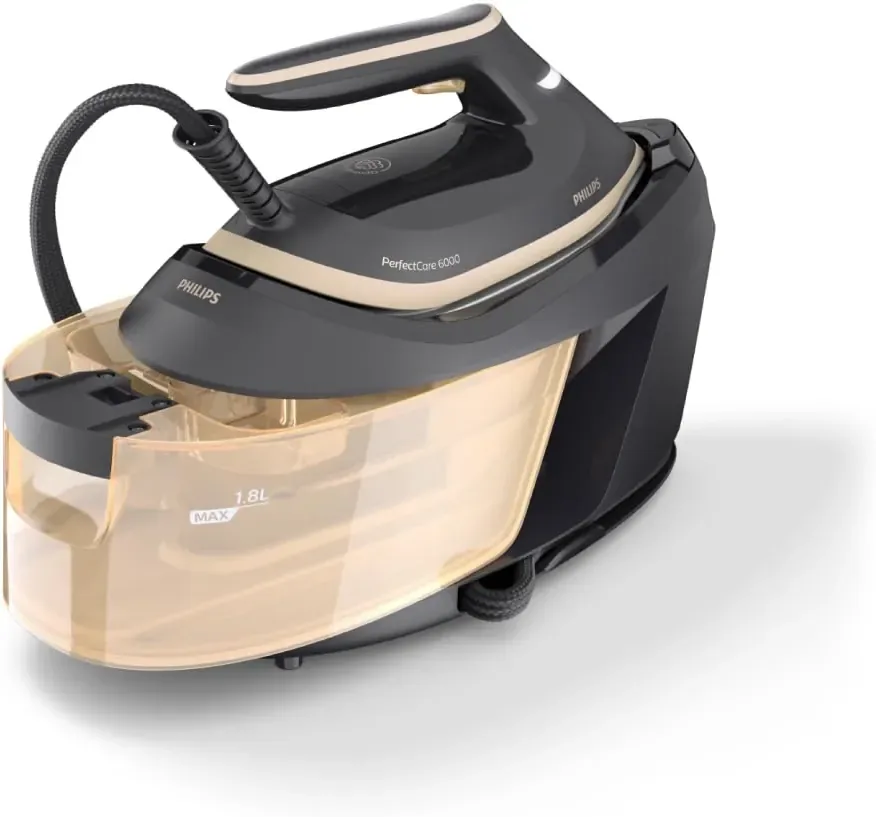
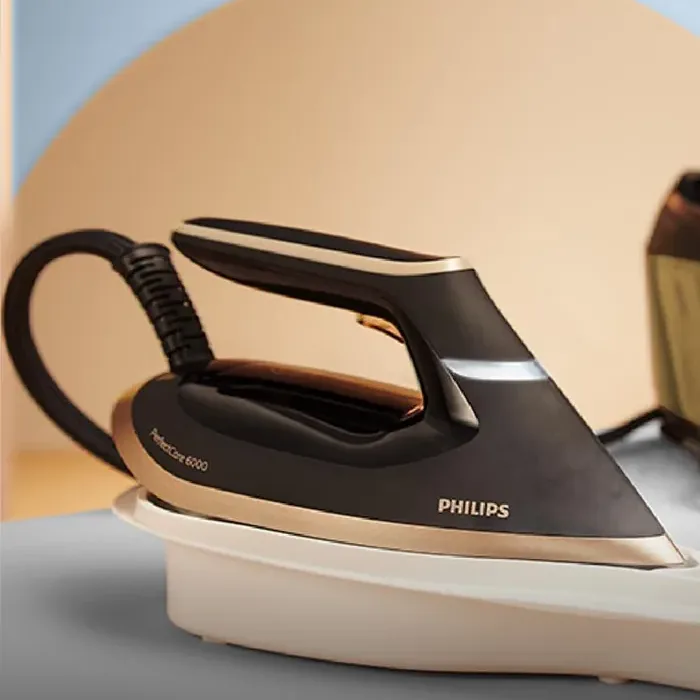
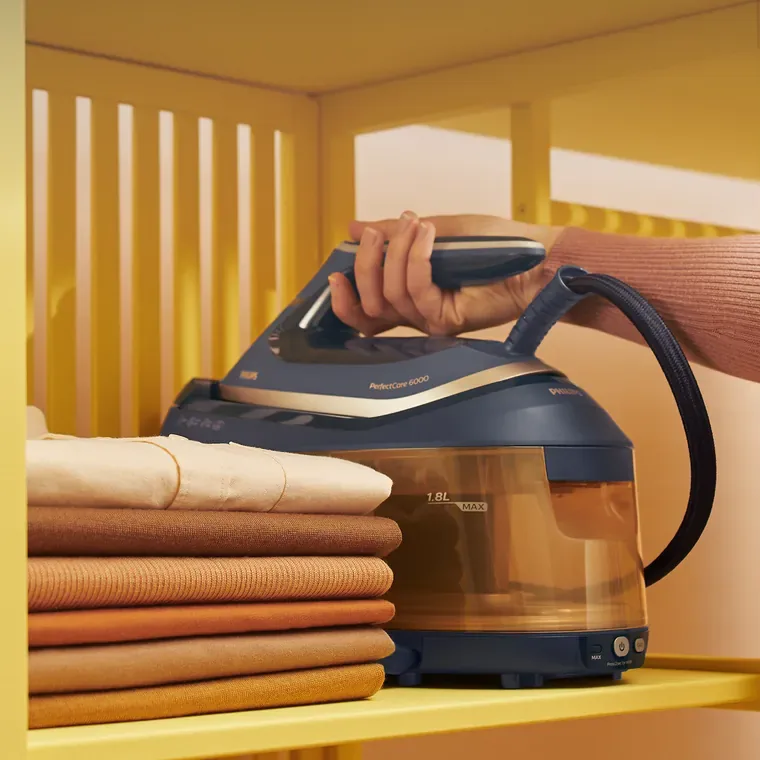
The Philips PerfectCare 6000 PSG6064/80 uses the Smart Calc Clean system, with a supplied Calc Clean container and a sound and light reminder, according to Philips documentation.
The Smart Calc Clean method step by step
Here is the general process for guided descaling on the PerfectCare 6000, as described by Philips and confirmed by verified buyers. Your appliance’s manual is still the reference: follow it first.
- Wait for the reminder. The descaling light and a beep tell you it is time.
- Fill the tank with water, to the amount given in the manual.
- Plug in and let it heat up if the manual says so.
- Stand the iron on the Calc Clean container, placed flat on a stable, heat-resistant surface.
- Start the process by pressing the dedicated button, as per the manual.
- Let the appliance flush the scaly water into the container, without moving the iron.
- Empty the container once the process is finished and the iron has cooled.
- Wipe the soleplate and test the steam on an old cloth before ironing anything.
Buyers describe the process as quick and simple, with the reminder coming every few months depending on their water and how much they iron.
Other methods: collector, cartridge, draining
The scale collector
On steam generators that have one, the collector traps limescale particles. You remove it, often from the side of the base, with the appliance cold and unplugged, rinse it and put it back. How often: according to the light or the manual.
The anti-scale cartridge
It filters the water before it reaches the generator. You replace it after the stated period or when the indicator says so. Check the cost and availability of refills before you buy.
Draining the boiler
On pressurised boiler models, you unscrew a drain cap with the appliance cold and unplugged, rinse with clean water and empty it over the sink. Never open a hot boiler: it is under pressure.
How often to descale
There is no universal frequency: it depends on your water hardness, how much you iron and the model. The simplest approach is to follow the appliance’s reminder if it has one. Otherwise, here are some common-sense guidelines:
| Use | Soft water | Medium water | Hard water |
|---|---|---|---|
| One session a week | Every two to three months | Every one to two months | Every two to four weeks |
| Several sessions a week | Every one to two months | Every two to four weeks | Every one to two weeks |
These are only guidelines: the manual’s instructions and the signs of limescale come first.
Vinegar, citric acid, descaler: what the manual says
White vinegar is often presented as a miracle descaler. For a steam generator, caution is needed. Several manufacturers advise against it: it can attack some seals and metal parts, leave a lingering smell and fail to clear limescale from narrow channels. Citric acid can also leave residues when heated. Other manufacturers specify a particular product.
- If the manual specifies a product, use it at the stated dose.
- If the manual rules out vinegar or citric acid, follow it, even if an online tutorial says otherwise.
- If the manual says nothing, contact the manufacturer’s customer service before improvising.
With a system like Smart Calc Clean, guided descaling uses water only, according to the Philips procedure: no product is needed.
Cleaning the soleplate
Over time the soleplate can lose its shine: limescale traces around the holes, starch or finishing residues, stuck fibres. Regular cleaning keeps it gliding and stops these residues transferring onto laundry.
- Unplug and wait until the iron is completely cold.
- Wipe the soleplate with a soft, damp cloth.
- For stubborn marks, add a drop of washing-up liquid, then wipe again with a clean damp cloth.
- Clear the holes with a cotton bud, without forcing.
- Dry with a dry cloth.
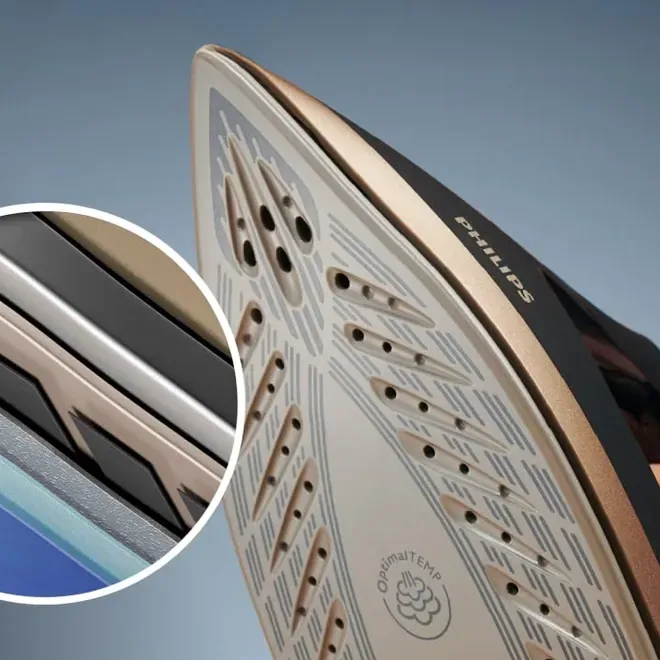
Avoid wire wool, scouring pads, cream cleaners and sharp objects: they scratch coatings, such as the six-layer coating on the PerfectCare 6000’s SteamGlide Advanced soleplate.
Everyday care
- Use the water recommended in the manual; Philips states that the PerfectCare 6000 is suitable for tap water.
- Empty the tank if the appliance will not be used for several days: standing water encourages deposits and smells.
- Release a burst of steam into the air at the start of each session to clear condensed water.
- Do not iron over zips and metal buttons, which scratch the soleplate.
- Wipe the cold soleplate regularly.
- Respond to the descaling reminder.
Storage
- Unplug and let the appliance cool.
- Empty the tank if you will not be ironing in the next few days.
- Lock the iron onto the base with the carry lock.
- Store the hose in its compartment without bending it sharply.
- Keep the steam generator somewhere dry and frost-free.
Common faults and fixes
| Symptom | Likely cause | What to do |
|---|---|---|
| No steam | Tank empty or not seated, heat-up not finished | Fill, reseat, wait for the signal |
| Weak steam | Limescale | Descale following the manual |
| Drops of water | Condensation in the hose, limescale | Burst into the air, descale |
| White marks | Limescale particles | Descale, rinse, test on a cloth |
| Brown marks | Burnt residue, unsuitable water | Clean the soleplate, descale, check the water |
| Very noisy pump, no steam | Tank empty or badly fitted | Fill and reseat the tank |
| The appliance no longer heats | Electrical fault | Do not take it apart, contact after-sales |
While under guarantee, do not attempt any repair yourself. The PerfectCare 6000 documentation mentions a 2-year guarantee, and in the UK you also have your statutory rights under the Consumer Rights Act 2015 against the retailer.
Marks on laundry: cause and remedy
| Mark | Likely cause | Remedy |
|---|---|---|
| White specks | Expelled limescale | Let dry, brush off, rewash if needed; descale the appliance |
| Water ring | Drops of condensation | Dampen the whole area lightly and iron again |
| Brown marks | Residue in the circuit, unsuitable water | Rewash the garment; rinse and descale the appliance |
| Grey soleplate-shaped mark | Dirty soleplate | Rewash; clean the soleplate when cold |
After descaling, always test the steam on an old, pale cloth before ironing a garment: you will see straight away if any residue remains.
Mistakes that damage the appliance
- Ignoring the descaling light for weeks.
- Adding things to the tank: perfume, starch, tumble dryer water.
- Descaling with a product not specified in the manual.
- Opening a hot boiler on pressurised models.
- Scraping the soleplate with something sharp or abrasive.
- Immersing the base or iron in water.
- Putting the appliance away hot and full of water.
The maintenance calendar
| When | What to do |
|---|---|
| Every session | Burst into the air at the start, iron on its rest during breaks, unplug at the end |
| If unused for several days | Empty the tank |
| Every month | Wipe the cold soleplate, check the holes |
| At the reminder or first signs | Descale following the manual |
| Every three months | Check the cord, hose and plug |
What durability tests show
Laboratory durability tests simulate far heavier use than a household that irons once a week. They separate appliances whose output drops quickly from those that hold up. Two practical lessons follow: even a good appliance eventually loses performance without maintenance in hard water, and the differences in resilience between models are real, so it is worth checking these tests before you buy if your water is very hard.
Safety during maintenance
- Unplug the appliance before any cleaning or handling of the tank outside normal use.
- Wait until it has cooled completely before touching the soleplate or emptying the descaling container.
- During descaling, keep your face and hands away from the steam and hot water being flushed out.
- Store descaling products out of children’s reach and never mix them.
- Never immerse the base or the iron in water.
Tank hygiene
Water left for several days at room temperature in a closed tank can develop a smell and a slight deposit. It is not serious, but it can transfer to laundry. Empty the tank if you will not iron for several days, leave it to dry open now and again, and rinse it with clean water if it smells. Do not use bleach or household cleaners in the tank: the residue would be steamed onto your clothes.
Five myths about limescale
- “Bottled water does not cause limescale.” It depends on the mineral content: some mineral waters are harder than tap water.
- “A new appliance does not scale up.” Limescale starts depositing from the first use; you just cannot see it yet.
- “The more you descale, the better.” Descaling too often with a harsh product can wear the seals. Follow the manual.
- “Vinegar always works.” Several manufacturers rule it out for their steam appliances.
- “As long as there is steam, all is well.” Output that drops slowly can go unnoticed for weeks.
Keep a simple maintenance log
Note the purchase date, your water hardness and the date of each descale, for example in a note on your phone. After a few months you will know the right rhythm for your water and usage. This information is also useful for customer service if something goes wrong, and it reminds you of the purchase date for the guarantee without hunting for the receipt.
End of life: repair or recycle
Before throwing away a faulty steam generator, check the guarantee and contact the manufacturer’s customer service: a faulty part can often be replaced. Out of guarantee, a repair shop or a repair café can diagnose the problem. If repair is not possible, the appliance counts as waste electrical and electronic equipment: take it to your household waste recycling centre, or to a retailer offering take-back when you buy a replacement. Never put it in your general waste bin.
Hard water: you are probably affected
Water hardness in the UK varies a great deal with geology. Much of the south and east of England, including London, has hard or very hard water from chalk and limestone, while large parts of Scotland, Wales, Northern Ireland and the north-west of England generally have softer water. These are only broad patterns: hardness can differ between neighbouring areas depending on where the supply comes from. The only reliable source is your water supplier.
If your water is over 300 mg/l, make maintenance a habit: empty the tank when the appliance is not in use, use water as advised in the manual, and descale at the first signs. A few minutes a month is enough to preserve the steam output.
Homes with a water softener
Many homes in hard water areas of the UK have a water softener fitted. Softened water does not form limescale in the same way, which can seem like the perfect answer for a steam generator. It is not that simple. A softener swaps calcium and magnesium for sodium, and the softened water carries more dissolved salts. Several steam appliance manufacturers advise against using it, because it can cause spitting or other deposits.
Most softened homes keep at least one unsoftened tap, usually the kitchen cold tap used for drinking water. That is normally the one to fill your steam generator from, unless the manual says otherwise. If you are not sure which taps are softened, a test strip will tell you quickly. And even with unsoftened tap water, keep descaling at the intervals the appliance suggests.
What limescale costs you
Limescale does not just damage the appliance: it wastes time and energy too. A heating element coated in scale transfers heat less well, so the appliance takes longer to reach temperature and produces less steam per kWh. With lower output, you go over the same areas more often and each session takes longer.
Then there is the risk to your laundry. A white shirt with brown specks has to be washed again, and some residue marks never fully come out. Compared with all that, a guided descale of a few minutes every few months is a tiny investment. Seen that way, the descaling reminder is not a nuisance: it is the cheapest way to keep the performance you had on day one.
If the problem continues after descaling
Sometimes, after descaling, a steam generator keeps spitting or producing little steam. Before assuming a fault, run the process a second time: an old deposit can take more than one cycle. Then check that the tank is properly seated and that you are using the water recommended in the manual. Release a few bursts of steam into the air to clear any water left in the hose. If the steam is still weak after these steps, or brown marks keep appearing, contact the manufacturer’s after-sales service without opening the appliance.
Making it last
A well-maintained steam generator can work for many years. Beyond limescale, a few precautions matter: do not pull on the cord or hose to unplug or move the appliance, do not drop it, do not use it with a damaged cord, and store it somewhere dry and frost-free. The seals and hose are sensitive parts: avoid bending the hose sharply when you put it away.
For everyday use, our user guide covers good practice, and our article which water for a steam generator iron explains how to choose your water.
The first descale
The first descaling reminder is a useful benchmark. Note how many weeks have passed since you bought it: that is the rhythm for your water and usage. During this first descale, look at the water flushed into the container: lots of white particles mean hard water, and you will know to respond promptly to future reminders. If the water comes out almost clear, your water is soft and the appliance will thank you for it.
After the first descale, run the steam generator for a moment over a cloth, then iron something you do not mind about before your usual laundry. That way you check that no leftover particles end up on your clothes.
Prevent rather than repair
Most limescale-related faults give plenty of warning: falling output, spitting, white specks, a longer heat-up. Spotting them early prevents deep scaling, which is harder to treat and sometimes irreversible. Get into the habit of comparing your appliance’s steam now and then with how it was in the first few weeks: if the difference is clear, it is time to descale, even if the light has not come on yet.
Before and after a long absence
Before going away for several weeks, empty the tank completely, let it dry open, then store the steam generator somewhere dry with the iron locked. If a descale is due soon, do it before you leave: limescale left inside dries out and hardens. When you get back, fill the tank with fresh water, let it heat up and release a few bursts of steam over a cloth before ironing. If the steam carries particles, run a descale.
In a holiday home with very hard water, or a property left empty for part of the year, this routine avoids most unpleasant surprises when you start ironing again.
Limescale as a buying criterion
If you have not chosen your steam generator yet, the anti-scale system deserves as much attention as steam output. An automatic or guided system with a reminder will get used; a fiddly one will end up ignored. In a hard water area, also check the durability results published by consumer testing organisations. Our guide how to choose a steam generator iron puts this criterion alongside the others.
Maintenance at a glance
Do
- Know your water hardness
- Use the water recommended in the manual
- Descale at the reminder or the first signs
- Clean the soleplate cold with a soft cloth
- Empty the tank if unused for a while
- Store the appliance cold, with the iron locked
Avoid
- Adding perfume, starch or vinegar to the tank
- Descaling with a product not specified
- Scraping the soleplate
- Immersing the appliance in water
- Taking the appliance apart yourself
- Ignoring a drop in steam output
These few rules are enough to keep a steam generator performing well for years, even with hard water. For the appliance itself, our reference model is the Philips PerfectCare 6000, whose guided descaling makes maintenance easy. And for choosing your water, read our article which water for a steam generator iron.
Above all, remember that looking after a steam generator comes down to a few simple actions, as long as you do them at the right time: the appliance’s reminder, or failing that the first signs of limescale, is your best guide. A few minutes of descaling at the right moment saves hours of ironing with a steam generator that has lost its puff.
One last point: if several people share the steam generator, agree who keeps an eye on the light and empties the container after descaling. Maintenance that is nobody’s job tends to be forgotten, and those are exactly the homes where steam generators scale up fastest.
Frequently asked questions
How do I know if my steam generator has limescale?
Less steam, spitting, white marks on laundry, a longer heat-up or the descaling light coming on.
Can you descale a steam generator with vinegar?
Only if the manual allows it. Several manufacturers advise against it because it can damage the seals. Follow the manufacturer’s method.
How do you descale the Philips PerfectCare 6000?
When the light comes on, fill the tank, stand the iron on the supplied Calc Clean container and start the process: the appliance flushes the limescale into the container. Follow the manual for the details.
How often should you descale?
It depends on your water hardness and usage. Follow the appliance’s reminder if it has one; otherwise every one to three months with medium water and one session a week.
Can you use tap water?
It depends on the manual. Philips states that the PerfectCare 6000 is suitable for tap water. With very hard water, the manual may recommend mixing it with demineralised water.
How do you clean a scaled soleplate?
When cold, with a soft damp cloth, a little washing-up liquid if needed, and a cotton bud for the holes. Never abrasives.
Does descaling void the guarantee?
Not if you follow the manual. Using a product that is not specified, or opening the appliance, can affect the guarantee.
Does a scaled-up steam generator use more electricity?
Limescale insulates the heating element: the appliance heats less well and produces less steam for the same energy. A well-maintained appliance is more efficient.
How long does descaling take?
Usually a few minutes for the process itself, plus heat-up and cooling time. Follow your model’s manual.
Crisp laundry, in less time.
8 bar · 150 g/min · 600 g steam boost · 2400 W · 1.8 L tank. The price changes often on Amazon: check it, along with the seller, the PSG6064/80 model number, the UK plug and the returns policy, before you order.
Check the price on AmazonAffiliate link · new tab