How to choose a steam generator iron: the complete guide
Bar figures everywhere, grams per minute, four-digit steam boosts: steam generator listings all look alike and muddy the water. Here are the criteria that really count, with clear thresholds, the traps to avoid and the right appliance for each type of household.
Contents
In short:
- A steam generator pays off from about ten items a week, or as soon as heavy fabrics make up most of your ironing.
- Look first at continuous steam output: 120 to 160 g/min for a household, more for very large loads.
- The steam boost matters for linen and denim; bar figures help comparison but do not tell the whole story.
- A single temperature makes ironing far simpler and protects delicate fabrics.
- The anti-scale system matters as much as performance: a scaled-up appliance loses its steam.
Start from your laundry, not the numbers
The first question is not “how many bar?” but “what do I iron, how much of it, and where?”. A very powerful steam generator adds nothing for someone who irons three T-shirts a week, and a compact model can disappoint a family that works through sheets and tablecloths every Sunday.
Take five minutes to answer these questions before you compare models:
- How many items a week? Fewer than ten, a steam iron may be enough. Between ten and twenty, a steam generator saves time. Beyond that, it becomes almost essential.
- Which fabrics? Fine cotton and synthetics iron well with any appliance. Linen, denim, sheets and tablecloths benefit from a steam generator’s output and boost.
- How much space? A shelf to store the appliance and somewhere to put up the board.
- Who irons? Someone with a sensitive wrist will prefer a light iron; several people sharing the ironing will appreciate a single temperature with no settings.
- What water? In a hard water area, the anti-scale system becomes a key criterion.
Our calculator turns these answers into a recommendation in a few seconds.
Types of steam generator
The pressurised boiler steam generator
Water is heated in a pressurised boiler inside the base. The steam is powerful and dry, but heat-up takes longer and refilling often means waiting for the boiler to cool and unscrewing a cap. It is the original design, still found on some models.
The instant steam generator
A pump sends water from a separate tank to a heating element at the moment you ask for steam. Heat-up is faster and the unpressurised tank can be refilled at any time. This is the most common design on household models today.
The compact steam generator
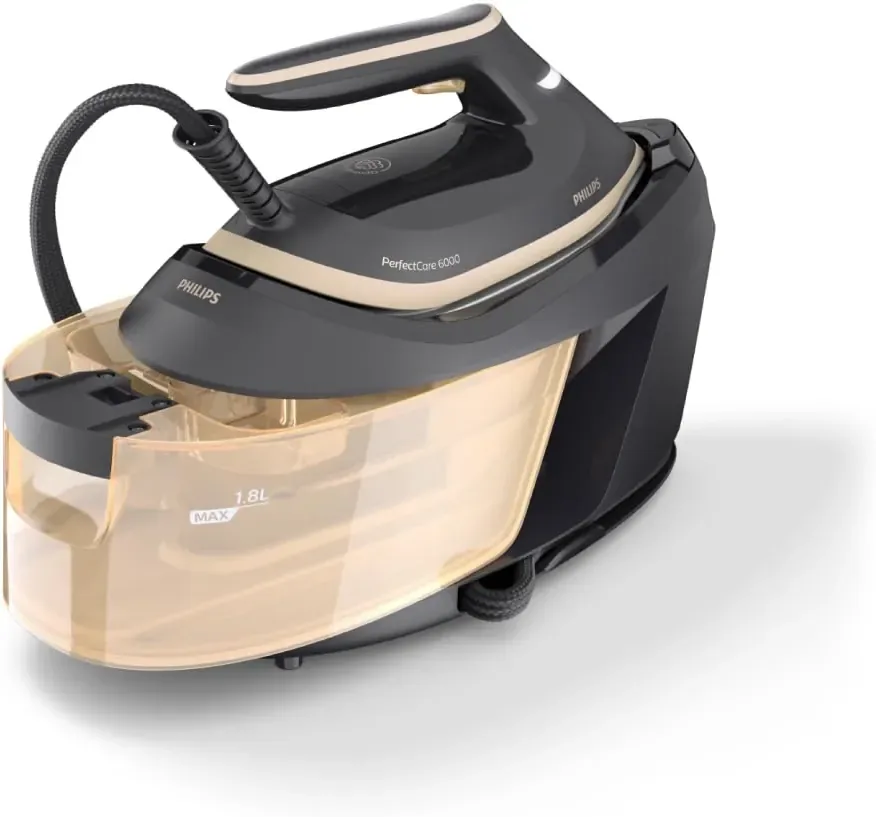
A smaller-format steam generator with a 1.5 to 1.8 L tank and steam output close to larger models. It is aimed at homes where space matters. The Philips PerfectCare 6000 (36.8 × 16.8 × 26.9 cm) belongs to this family. Read our article on the compact steam generator iron.
The ironing system
A steam generator built into an ironing board, sometimes with suction and blowing. Very comfortable for big volumes, but bulky and expensive. It is usually compared in a category of its own.
| Type | Heat-up | Refilling | Size | Who it suits |
|---|---|---|---|---|
| Pressurised boiler | Longer | Often when cold | Medium to large | Fans of dry steam |
| Instant generator | 1 to 2 min | At any time | Medium | Most households |
| Compact | 1 to 2 min | At any time | Small | Smaller homes |
| Ironing system | Varies | Varies | Very large | Very large loads |
Criterion 1: continuous steam output
Continuous steam output is the amount of steam produced each minute while you iron, in grams per minute. It is the best indicator of speed: the higher it is, the more easily steam gets through thick fabrics in one pass, and the less often you go over the same area twice.
| Continuous output | What to expect |
|---|---|
| Under 100 g/min | Close to a very good steam iron, little point in a steam generator |
| 100 to 130 g/min | Entry level: fine for moderate use |
| 130 to 160 g/min | Mid-range: quick across a household’s whole wash |
| Over 160 g/min | Premium: very large loads, heavy fabrics every day |
The Philips PerfectCare 6000 PSG6064/80 claims 150 g/min. Watch the figures: some listings highlight a “maximum output” that is actually the boost. Only continuous output reflects a real ironing session. Laboratory tests measure it by weighing the appliance before and after the test, following the European standard for irons, EN 60311, which makes it possible to compare models from different brands.
Criterion 2: the steam boost
The steam boost, or shot of steam, is a short burst released on demand for a few seconds. It is measured in grams and ranges from 250 g on entry-level models to over 700 g on the most powerful ones.
It matters for stubborn creases: the knees of jeans, linen that creased while drying, the collar of a shirt straight out of a suitcase, thick hems. For the rest of the ironing, continuous output does the work. A high boost with low continuous output gives you an appliance that impresses in a demo and disappoints over a long session.
The PerfectCare 6000 claims a steam boost of up to 600 g, which puts it on a par with many bulkier steam generators.
Criterion 3: pump pressure
Pressure, in bar, is the maximum pressure of the pump that pushes water to the heating zone. It helps steam come out forcefully and penetrate the fabric. Typical models claim 5 to 8 bar, sometimes more.
This figure is often over-interpreted. Two 7-bar steam generators can produce different amounts of steam, and a well-designed 6-bar model can remove creases as well as an 8-bar one. Pressure helps when comparing models from the same brand; across brands, continuous output and independent tests are more reliable. Our article on pressure, bar and steam output explains these terms in detail.
Criterion 4: temperature control
Traditional steam generators have a thermostat, often with three dots, just like an iron. You have to sort your laundry, start with the fabrics that tolerate heat least, and wait for the soleplate to heat up or cool down between batches.
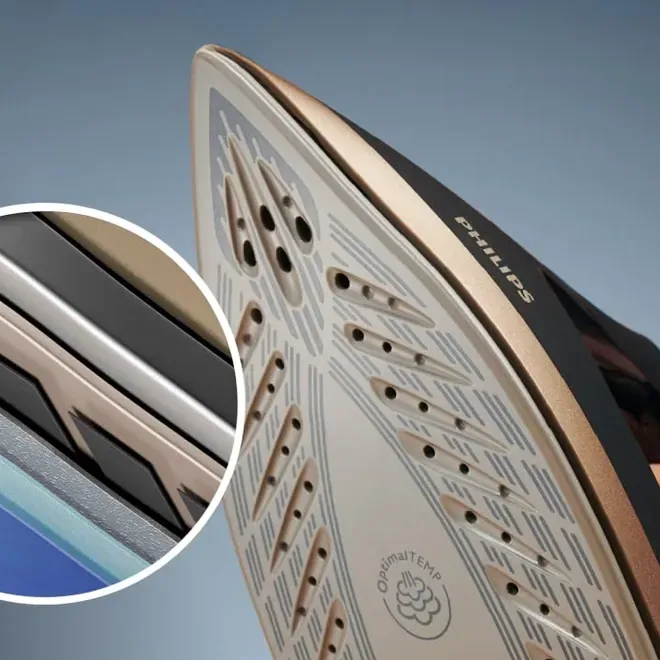
Single-temperature models change the game. They pair a soleplate temperature and a steam output calibrated to remove creases from every ironable fabric without burning it. At Philips this technology is called OptimalTEMP: the manufacturer guarantees no burns on ironable fabrics, even if the iron is left resting on the garment. Other brands offer automatic settings or fabric programmes.
For a household where several people iron, or for anyone who has already scorched a viscose blouse, a single temperature is a real comfort. Purists who like fine control will prefer a thermostat.
Criterion 5: the soleplate
The soleplate needs to glide, resist scratches and spread steam evenly. Multi-layer, ceramic and treated steel coatings dominate the market, under each brand’s own trade names.
- Glide reduces the effort on your wrist, especially over large areas.
- Scratch resistance keeps the glide over time: a scratched soleplate drags and can mark fine fabrics.
- Steam holes should be plentiful and spread right to the tip for even steam.
- A precision tip makes collars, cuffs and buttonholes easier.
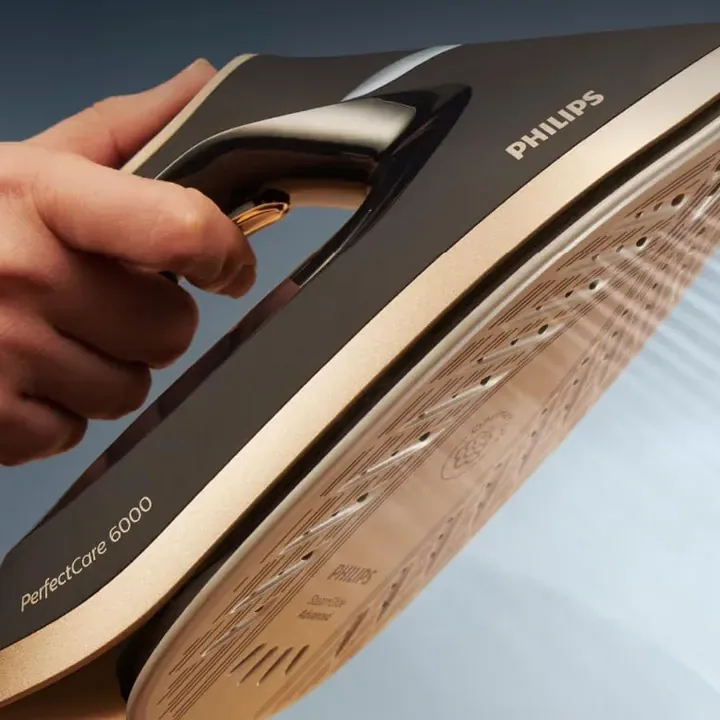
The PerfectCare 6000 uses the SteamGlide Advanced soleplate, with a six-layer coating on a stainless steel base, which Philips rates 5 stars for glide and scratch resistance.
Criterion 6: the water tank
Three points matter. Capacity: from 1.2 to over 2 L; at around 1.8 L, a family session goes by without a refill. Whether it is removable: a tank that comes off can be filled at the tap, without a jug. Refilling at any time: on instant steam generators, you top up mid-session without waiting.
The PerfectCare 6000 has a transparent 1.8 L tank, removable and refillable at any time, for which Philips claims up to 1 hour 30 minutes of continuous use.
Criterion 7: limescale management
Limescale is the number one enemy of steam appliances. It builds up in the circuits, reduces output, causes spitting and stains, and ends up blocking the appliance. Durability tests at some laboratories measure steam output over time precisely to separate models on this point.
| System | How it works | What to check |
|---|---|---|
| Scale collector | A container you empty regularly | Easy access, how often |
| Anti-scale cartridge | A cartridge filters the water | Cost and availability of refills |
| Guided rinse | The appliance flushes out scale on demand | Simple procedure, automatic reminder |
| Drain plug | You rinse the boiler by hand | Access, waiting for it to cool |
The PerfectCare 6000 uses the Smart Calc Clean system: a light and a beep remind you when it is due, you stand the iron on the supplied container, and the appliance flushes out the scale. Verified buyers describe the process as simple and needed only every few months. Our guide how to descale a steam generator iron covers the methods in detail.
Criterion 8: iron weight
The iron on a steam generator usually weighs between 0.8 and 1.3 kg. A light iron is less tiring on the wrist and shoulder over a long session; a heavier one presses down more on thick fabrics. On a steam generator, steam does most of the work, which allows lighter irons than a standard steam iron.
The PerfectCare 6000’s iron weighs 1.2 kg according to Philips, a middle-of-the-range figure. Buyer opinions are split, as they often are on this point: many find it light, a few would have liked it lighter still.
Criterion 9: size
A steam generator takes up room on the board while you iron and on a shelf between sessions. Check the dimensions, the total weight and how the hose and cord are stored. A carry lock, which holds the iron on its base, lets you carry the appliance in one hand without touching the soleplate.
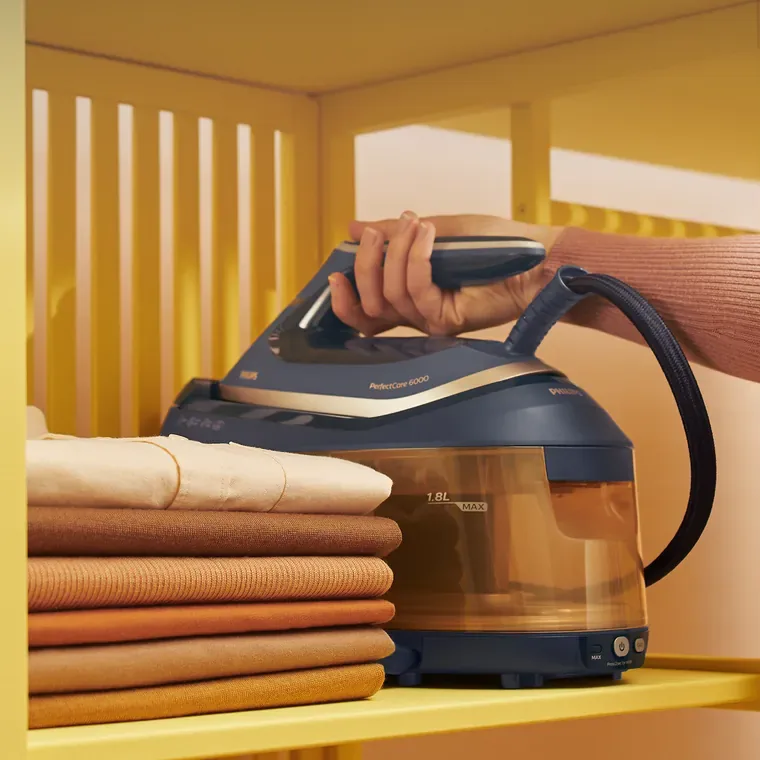
The PerfectCare 6000 measures 36.8 × 16.8 × 26.9 cm and weighs 3.4 kg with the iron, with a hose compartment, a cord clip and a carry lock.
Criterion 10: safety
- Auto shut-off turns the appliance off after a period of inactivity. Check that it is there and how long it takes, in the manual.
- The carry lock keeps the iron secured on its base.
- A stable base stops it falling when you pull on the hose.
- Cord and hose length: around 1.6 to 1.8 m each, so they are not stretched.
- Anti-drip limits leaks as the temperature drops.
- A no-burn guarantee on fabrics, where offered, protects your laundry from moments of distraction.
For the PerfectCare 6000, Philips lists auto shut-off, a carry lock and anti-drip, with a 1.65 m cord and a 1.6 m hose.
Criterion 11: noise
A steam generator’s pump can be heard each time you press the trigger, as a hum or a series of quick clicks. Some models include noise reduction. If you iron in the evening, in a small flat or near a child’s bedroom, read buyer reviews carefully on this point. For the PerfectCare 6000, verified buyers find it a little noisier than some models, without it getting in the way.
Criterion 12: the plug
The UK runs on 230 V, which is compatible with European appliances rated 220 to 240 V. The difference is the plug. Models sold for the UK market come with a three-pin plug fitted with a fuse; models sold for continental Europe have a two-pin plug. The PSG6064/80 is a European reference, so check the listing carefully: look for a UK plug, or for a UK-specific version of the model.
If you end up with a European plug, use a properly rated, fused adaptor that complies with British safety standards, and never a cheap travel adaptor, since a 2400 W appliance draws a high current. The safest option is to buy a version supplied with a UK plug from the start. Check that the manual and the warranty apply in the UK as well.
Traps in product listings
- The boost presented as output. A three-digit g/min figure is often the boost; look for the word continuous.
- Bar as the only selling point. It says nothing about the amount of steam.
- Power in watts. It tells you about heating, not the end result.
- The weight of the iron alone. Check the total weight and base stability too.
- Promises of professional results. The result also depends on the board, your technique and the laundry.
- Multiple model numbers. The same range exists under several references with different outputs and plugs: check the exact reference.
The right steam generator for each household
| Household | Recommended appliance | Priority criteria |
|---|---|---|
| Couple ironing weekly, small home | Compact steam generator | Output, size, single temperature |
| Family with lots of sheets and jeans | High-output steam generator | Output, boost, tank, limescale |
| Fan of perfectly pressed shirts | Steam generator with a precision tip | Soleplate, output, iron weight |
| Someone with a sensitive wrist | Steam generator with a light iron | Iron weight, glide |
| Very hard water area | Steam generator with easy descaling | Anti-scale system, reminder |
| Small amount of light laundry | Steam iron or handheld steamer | Simplicity, size |
For the first three profiles, the Philips PerfectCare 6000 ticks the main boxes. For a very large family, a more powerful model may be justified; for small loads, an iron is enough.
Budget: what you gain by moving up the range
We do not quote prices, which change often. The differences between ranges translate into concrete features.
- Entry level: output around 100 to 120 g/min, manual thermostat, sometimes a fixed tank, manual scale rinse. Enough for moderate use.
- Mid-range: output of 130 to 160 g/min, removable tank, often a single temperature and guided descaling. The best balance of comfort and price for a household, and the range the PerfectCare 6000 sits in.
- Premium: higher output, boost above 700 g, automatic fabric detection, noise reduction, better finish.
For most households, mid-range is enough. Moving up is mainly justified for very large loads or intensive daily use.
Electricity use, in figures
A 2400 W steam generator does not draw that power constantly: the heating element switches on and off to hold the temperature. For a cautious estimate, you can take the maximum power as a reference. One hour of ironing a week for a year then works out at no more than about 124.8 kWh.
At a reference rate of 27.64p per kWh, the Ofgem price cap for direct debit customers for October to December 2026, that comes to at most around £34.49 a year. Real consumption is usually lower, because the heating element does not run all the time. Your bill depends on your tariff, any time-of-use rates and how often you iron: our calculator lets you enter your own unit rate. In practice, running cost weighs little in the choice compared with steam output, limescale or size, and ironing in batches cuts the number of heat-ups.
Where to find independent tests
Consumer organisations such as Which? in the UK regularly test steam generator irons in the lab, using appliances bought from shops. They typically assess steam output, crease removal on several fabrics, resistance to limescale and ease of use. Some of the results are usually reserved for members.
These sources are valuable for choosing between two similar models. Read the test method as well as the ranking: it explains what was measured and under what conditions.
The main brands
The steam generator market is dominated by a handful of big laundry-care brands, including Philips, Tefal, Rowenta, Braun, Bosch, Morphy Richards, Russell Hobbs and Laurastar, with ranges from entry level to full ironing systems. Some highlight repairability commitments, such as spare parts being available for several years.
The brand is not everything. Two models from the same brand can have very different outputs, soleplates and anti-scale systems. Always compare using the criteria in this guide, not the logo. One point does deserve attention: the availability of documentation, spare parts and after-sales service in the UK.
Do not forget the ironing board
A steam generator performs best on a good board. Three points matter. The generator rest needs to be wide and stable enough for the base; if not, put the appliance on a table alongside. The cover must let steam through: a thick, breathable cover with a foam or felt layer stops moisture sitting under the laundry. Adjustable height lets you iron at hip level without stooping.
A narrow or wobbly board wastes part of the benefit of a steam generator. If your board is more than ten years old, a new cover often improves results noticeably.
Your rights, repairs and durability
- Your statutory rights: under the Consumer Rights Act 2015, goods must be of satisfactory quality and as described; you have 30 days to reject a faulty item for a refund, and can seek a repair or replacement after that.
- The cancellation period: for online purchases, you generally have 14 days to cancel after delivery.
- The manufacturer’s guarantee, on top of your statutory rights. Philips states 2 years for the PerfectCare 6000; check the terms that apply in the UK.
- After-sales service: phone line, online form, authorised repairers. Keep your receipt.
Descaling with a product not specified in the manual, or opening the appliance, can affect the guarantee. Another reason to follow the manufacturer’s instructions.
Refurbished and second-hand
Refurbished steam generators, sold by retailers or the manufacturer after inspection, can be a sensible way to save money, provided they come with a clear warranty. Second-hand ones bought privately are a bigger gamble, because limescale is invisible from the outside.
If you consider a used model, ask how often it was descaled and what water it was used with, check that the soleplate is not scratched or stained, and test it if you can: steady steam, no spitting, no leaks from the hose. Check that the descaling accessories are included and that the hose shows no cracks. Avoid any appliance that has been opened or repaired outside an authorised service centre. In most cases, the peace of mind of a new or properly refurbished unit is worth the difference.
The most common buying mistakes
- Buying a steam generator for three shirts a month. It will gather dust; an iron or handheld steamer would have done.
- Choosing on bar figures. Continuous output says more about effectiveness.
- Overlooking limescale. In a hard water area, a fiddly system gets abandoned and the appliance scales up.
- Forgetting about size. Measure the shelf where it will live.
- Ignoring noise. In a small flat, you will hear the pump.
- Not checking the plug. A European-plug model needs a suitable, fused adaptor.
Reading a product listing: an example
To put these criteria into practice, let us take the Amazon listing for the Philips PerfectCare 6000 PSG6064/80 and read it line by line.
| The listing says | What it means |
|---|---|
| “8 bar” | Maximum pump pressure, at the top of the usual range. |
| “Steam 150 g/min” | Continuous output: the right measure of speed, at the upper end of mid-range. |
| “Steam boost 600 g” | Short burst for stubborn creases. |
| “2400 W” | Typical heating power for a household steam generator. |
| “OptimalTEMP” | Single temperature, guaranteed not to burn ironable fabrics according to Philips. |
| “SteamGlide Advanced” | Soleplate with a six-layer coating on a stainless steel base. |
| “1.8 L removable tank” | Fill at the tap, at any time; up to 1 hour 30 claimed. |
| “Compact and practical” | 36.8 × 16.8 × 26.9 cm, 3.4 kg, carry lock. |
What is missing is just as instructive: no noise level in decibels and no exact auto shut-off time on the listing. These are not deal-breakers, but they are worth knowing. Our specifications page lists every figure with its source.
The first few weeks with a steam generator
Switching from an iron to a steam generator takes a few sessions to get used to. The amount of steam is surprising at first: you tend to use too much on thin fabrics, which stay damp. Slow down on heavy laundry, speed up on light fabrics, and finish with a pass without steam if something is still damp.
Get into the habit of the first burst into the air, hanging laundry as soon as it is ironed, and emptying the tank if the appliance will sit unused for several days. Note the date of the first descaling reminder: it will give you the rhythm for your water. Our user guide goes through these steps one by one.
Useful accessories
A few accessories round out a steam generator nicely: a board with a wide generator rest, a breathable cover, a sleeve board and a spray bottle to dampen dry laundry. Models supplied with a descaling container, like the PerfectCare 6000, save you buying a suitable one. Be wary of gimmicky accessories that rarely get used.
Before you order, take the time to read the manual for the model you are considering, often available online on the manufacturer’s website: it tells you the recommended water, the descaling procedure and the auto shut-off times, information that does not always appear on the product listing.
The checklist before you buy
- I have estimated how much I iron and which fabrics dominate.
- I have compared continuous output, not just bar figures.
- I have checked the boost if I iron heavy fabrics.
- I know whether I want a single temperature or a thermostat.
- The tank is removable, at least 1.5 L and refillable at any time.
- The anti-scale system is simple and suits my water.
- The iron weight suits me.
- I have measured the storage space.
- The plug is a UK plug, or I have a suitable fused adaptor.
- I have checked the exact reference, the seller and the returns policy.
Frequently asked questions
What is the most important criterion when choosing a steam generator iron?
Continuous steam output, followed by the anti-scale system. The first determines speed, the second how long the performance lasts.
How many bar do you need?
Between 5 and 8 bar for a household steam generator. The figure helps comparison, but continuous output in g/min matters more.
What tank size should you choose?
Around 1.5 to 1.8 L for a family session without refilling. A removable tank that can be refilled at any time is more practical.
Is a single temperature as effective as a thermostat?
On most ironable fabrics, yes, and it removes the risk of mistakes. Models like the PerfectCare 6000 with OptimalTEMP are guaranteed not to burn fabrics by the manufacturer.
Is a compact steam generator less effective?
Not necessarily: the PerfectCare 6000 claims 150 g/min and a 600 g boost in a compact format. Very large loads may justify a more powerful model.
Do you need a special ironing board?
A stable board with a wide generator rest and a breathable cover makes a big difference to comfort and results.
Crisp laundry, in less time.
8 bar · 150 g/min · 600 g steam boost · 2400 W · 1.8 L tank. The price changes often on Amazon: check it, along with the seller, the PSG6064/80 model number, the UK plug and the returns policy, before you order.
Check the price on AmazonAffiliate link · new tab