Pressure, bar, steam output and boost: reading a steam generator’s figures
6 bar, 8 bar, 150 g/min, a 600 g boost, 2400 W: steam generator listings line up figures that do not measure the same thing. Here is what each one means, what it does not tell you, and how to compare two models without getting it wrong.
Contents
Four figures, four realities
On a steam generator listing, four figures almost always appear: pressure in bar, continuous steam output in grams per minute, the steam boost in grams and power in watts. They are linked, but none of them on its own sums up how well an appliance works. Marketing tends to push the most impressive one, which is not necessarily the most useful.
| Figure | Unit | What it measures | Everyday usefulness |
|---|---|---|---|
| Pressure | bar | The force of the pump | Medium, for comparing within a range |
| Continuous output | g/min | Steam produced continuously | High, it is the speed indicator |
| Steam boost | g | The one-off burst | High for heavy laundry, occasional |
| Power | W | Heating energy | Indirect, affects heat-up and consistency |
This guide complements our cornerstone article on how to choose a steam generator iron.
Pressure in bar
The bar is a unit of pressure: 1 bar is roughly atmospheric pressure at sea level. On a steam generator, the figure usually refers to the maximum pressure of the pump that pushes water from the tank to the heating chamber, or to the boiler pressure on models that have one.
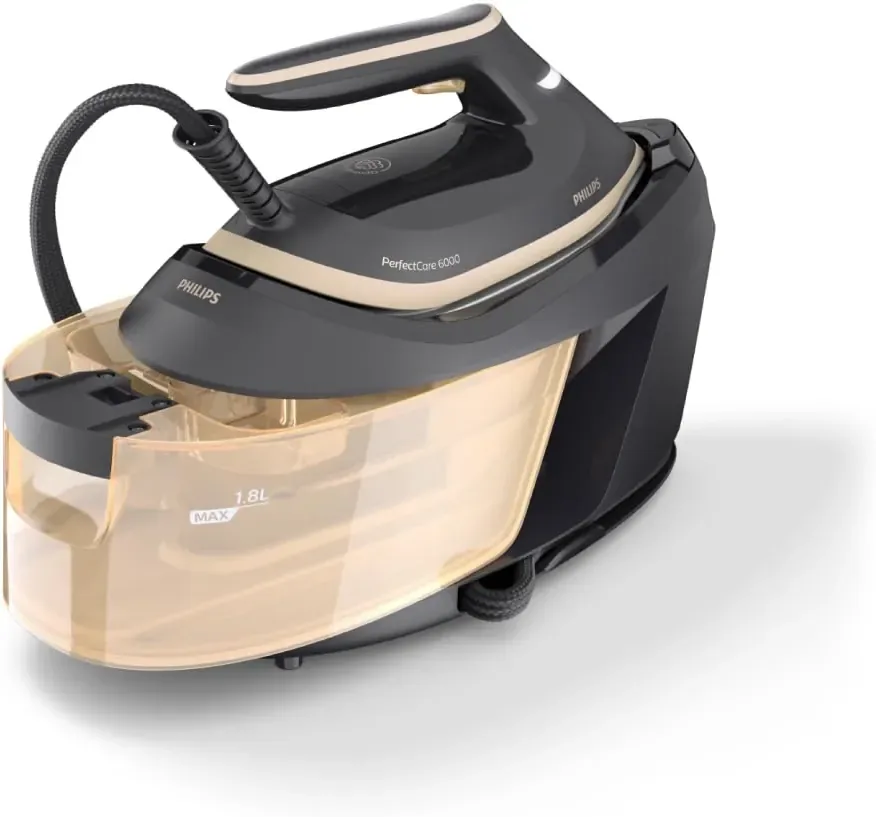
Higher pressure helps steam come out forcefully through the soleplate holes and get into the fabric. That is useful on thick, tightly woven fabrics: canvas, denim, heavy linen. Typical steam generators are rated between 5 and 8 bar, some a little higher. The Philips PerfectCare 6000 PSG6064/80 is rated at 8 bar.
The figure has its limits. It gives a maximum pressure, not the amount of steam produced. It says nothing about how the circuit is designed, how the steam is spread across the soleplate or how consistent it stays over a long session. Measurements published by the Belgian consumer association Test Achats also show that the measured maximum pump pressure can differ from the stated one: on a closely related PerfectCare 6000 model, the measured maximum water pump pressure is given as 6.5 bar. Treat the figure as a rough guide, useful for comparing models from the same brand.
Continuous steam output
Continuous output is the amount of water turned into steam every minute while you iron. It is the figure closest to real-life experience: with more steam, heat and moisture get into the fabric better, the fibres relax faster and you go over the same area twice less often.
| Appliance | Typical continuous output |
|---|---|
| Standard steam iron | 30 to 60 g/min |
| Entry-level steam generator | 100 to 120 g/min |
| Mid-range steam generator | 130 to 160 g/min |
| High-end steam generator | Over 160 g/min |
These ranges come from manufacturers’ specification sheets. The PerfectCare 6000 PSG6064/80 is rated at 150 g/min, at the upper end of the mid-range. Be wary of listings that show a three-digit “maximum steam” figure: it is often the boost dressed up as output. The word to look for is continuous.
Continuous output also sets the running time: a 1.8 L tank at 150 g/min gives about 12 minutes of non-stop steam. Since you do not hold the trigger down all the time, a real session lasts much longer, hence the 1 hr 30 running time quoted on the PerfectCare 6000’s Amazon listing.
The steam boost
The steam boost, also called a shot of steam or burst, is a one-off release you trigger on demand. It is measured in grams over a short period and ranges from about 250 g on small models to over 700 g on the most powerful. The PerfectCare 6000 is rated at up to 600 g.
It is for stubborn creases: the knees and pockets of jeans, linen crumpled in the dryer, thick hems, a collar that spent the night in a suitcase. You use it in short bursts of a few seconds, then go over the area with continuous steam or dry to set it. Some PerfectCare 6000 buyers mention a boosted mode triggered by pressing twice.
A big boost figure is a good selling point, as long as continuous output keeps up. A steam generator with a strong boost and weak output looks impressive in a demo but slows you down over a full session.
Power in watts
Electrical power tells you how much energy is available to heat the water and the soleplate. It affects how fast the unit heats up and how well it keeps producing steam without the temperature dropping. Typical steam generators range from 2200 to 3000 W; the PerfectCare 6000 is rated at 2400 W.
Power says nothing about the end result, which depends on the steam circuit, the soleplate and the overall design. It is mostly useful for estimating consumption: at most 2.4 kWh per hour for a 2400 W appliance. Our calculator turns that into pounds at your own rate.
How these figures fit together
An effective steam generator combines enough power to turn plenty of water into steam without cooling down, a pump that pushes water steadily, high continuous output and a soleplate that spreads the steam well. If one link is weak, the whole chain suffers: a strong pump without enough watts produces wet steam that dampens the laundry; lots of power without good distribution leaves patches poorly treated.
That is why no single figure is enough, and why independent tests that measure the result on real fabric are so valuable.
How labs measure
Que Choisir, the French consumer association, measures continuous steam output to European standard 60311. The iron, preheated and set to maximum, releases steam on a defined cycle, and the output is worked out from the difference in the appliance’s weight between the start and the end of the test. For models tested before 2019, the protocol describes an 8-minute cycle with steam on for 5 seconds every 20 seconds.
Crease removal is assessed on several creased fabrics, with the iron mounted on a test bench and weighted with a mass equivalent to the weight of a human arm, so that every appliance works under the same conditions. An endurance test tracks how output changes, measured every 12 hours, to spot appliances that lose steam as limescale builds up. Que Choisir says it has tested more than a hundred steam generators.
Test Achats publishes measured specifications: the actual weight of the iron, the measured tank volume, the length of the steam hose, maximum pump pressure and auto shut-off time. These figures let you check what manufacturers claim.
Which values to look for
| Your laundry | Continuous output | Steam boost | Pressure |
|---|---|---|---|
| A few light tops | An iron is enough | Not a priority | Not a priority |
| A couple’s mixed basket | 120 to 140 g/min | 300 to 450 g | 5 to 7 bar |
| Family basket with sheets | 140 to 160 g/min | 450 to 600 g | 6 to 8 bar |
| Lots of linen and denim | 150 g/min or more | 600 g or more | 7 bar or more |
| Very large daily loads | 160 g/min or more | 700 g or more | 7 bar or more |
These are guide values. They show that the PerfectCare 6000, with a stated 150 g/min, 600 g and 8 bar, covers most family baskets, heavy fabrics included.
Comparing two steam generators: a method
- Check continuous output, making sure it really is the continuous figure and not the boost.
- Compare the boost if you often have heavy laundry.
- Look at pressure as a secondary indicator.
- Read independent tests for real crease removal and endurance.
- Compare anti-scale systems, which decide whether output holds up over time.
- Factor in comfort: iron weight, single temperature, noise, footprint.
Example: the PerfectCare 6000 decoded
Let us apply the method to the PSG6064/80. Continuous output of 150 g/min: upper mid-range, suited to a family basket. Boost of up to 600 g: on a par with many bulkier steam generators, useful for linen and denim. 8-bar pump: at the top of the usual range. 2400 W: standard power for this level of output, with maximum consumption of 2.4 kWh per hour.
Add to that OptimalTEMP’s single temperature, which rules out setting errors, and Smart Calc Clean descaling, which helps keep output up over time. All in a compact format. Our full review covers each point.
Other figures that matter
- Tank capacity: how long you can iron without stopping.
- Iron weight: usually 0.8 to 1.3 kg; 1.2 kg for the PerfectCare 6000.
- Heat-up time: 1 to 2 minutes; about 2 minutes for the PerfectCare 6000.
- Hose and cord length: around 1.6 to 1.8 m.
- Dimensions: decisive when it comes to storage.
Units, conversions and your plug socket
A few simple conversions make listings easier to read, especially when a manufacturer uses different units or when you compare a European model with an American review.
| Figure | Equivalent | Why it helps |
|---|---|---|
| 1 bar | 100 kPa, about 14.5 psi | Comparing listings that give pressure in psi or kPa |
| 1 g of steam | About 1 ml of water | Turning g/min into water use |
| 150 g/min for a full hour | 9 litres of water | Understanding why the tank lasts longer in practice |
| 2400 W at 230 V | About 10.4 A | Choosing the right socket and avoiding overloaded extension leads |
The last line has a practical consequence. A UK plug is fused at up to 13 A and a typical extension lead is rated at 13 A in total, so a 2400 W steam generator uses most of that on its own. Plug it straight into a wall socket where you can, and avoid running it on the same extension lead as a heater or kettle at the same time. A four-way lead with an iron, a heater and a kettle all switched on is a common cause of overloaded sockets.
If you read American reviews, remember that US models run on 120 V and are often quoted at lower wattages, around 1500 to 1800 W. Their figures are not directly comparable with a 230 V European steam generator.
Common myths
- “More bar is always better.” Not necessarily: continuous output and design matter more.
- “The boost is the steam output.” No, it is a one-off burst lasting a few seconds.
- “More watts, more steam.” Power helps, but the circuit and pump decide the result.
- “Steam generators make laundry wet.” Not if the unit is hot enough and your technique is right; wet steam usually means it has not fully heated or there is limescale.
- “The figures are all you need to choose.” Independent tests and real-world feedback are a useful complement to the listings.
To go further, our guide on how to choose a steam generator iron puts these figures alongside the other criteria, and our article on how to descale a steam generator iron explains how to keep the output up over time.
One last practical tip: when you compare two listings, copy the four figures side by side into a table, noting for each whether it is a continuous figure or a peak. That simple habit avoids most misleading comparisons, and it often shows that a model billed as “more powerful” is only ahead on the least useful figure.
From figures to feel
How do these figures show up on the ironing board? High continuous output is noticeable first on large areas: a sheet or tablecloth smooths out in one pass instead of two or three. A good boost is felt on stubborn creases, which give way at once instead of fighting back. High pressure shows in the way steam gets through denim or heavy canvas: the fabric heats right through and the crease disappears on the reverse side too. Power is mostly noticed when it is lacking: an underpowered steam generator produces wetter steam that dampens the laundry towards the end of a session.
That is why two steam generators with similar listings can feel quite different in use. Independent tests that measure real crease removal on several fabrics let you look beyond the numbers.
Why the figures have crept up
Steam generators in the 2000s were often rated at 3 to 5 bar with outputs of around 80 to 100 g/min. Current models frequently exceed 6 bar and 120 g/min, even at entry level. That progress comes from more responsive instant generators, better pumps and soleplates that spread steam more evenly. It has also fuelled a numbers race: a recent 8-bar model is not necessarily twice as effective as an older 4-bar one. What has really changed for users is how consistent the steam is and the ability to refill the tank at any time.
Frequently asked questions
What does the bar figure mean on a steam generator?
The maximum pressure of the pump that pushes water to the heating chamber. It helps steam get into thick fabrics, but it does not measure how much steam is produced.
How many bar does a good steam generator need?
Between 5 and 8 bar for home use. Continuous output in g/min is a better guide to performance.
What is the difference between continuous output and boost?
Continuous output is the steam produced all the time while you iron; the boost is a one-off burst lasting a few seconds for stubborn creases.
Is 150 g/min good?
Yes, it is at the upper end of the mid-range, suited to a family basket that includes heavy fabrics.
Does a 2400 W steam generator use a lot of electricity?
At most 2.4 kWh per hour. For one hour a week, at most about £34.49 a year at the Ofgem price cap rate of 27.64p per kWh.
Crisp laundry, in less time.
8 bar · 150 g/min · 600 g steam boost · 2400 W · 1.8 L tank. The price changes often on Amazon: check it, along with the seller, the PSG6064/80 model number, the UK plug and the returns policy, before you order.
Check the price on AmazonAffiliate link · new tab