Steam generator or steam iron: which should you choose?
A steam generator promises to cut your ironing time; a steam iron stays simpler and takes up less space. This comparison explains what each appliance really does, fabric by fabric and situation by situation, so you avoid a purchase that ends up at the back of the cupboard.
Contents
The short answer
A steam generator is the best tool for getting through a big basket quickly, especially heavy fabrics. A steam iron is still enough, and more practical, for a small amount of light laundry. A handheld steamer complements either for touch-ups and travel. For most households, the right question is not “one or the other” but “which main appliance, and do I need a second one”.
| You mostly iron… | And you iron… | Main appliance |
|---|---|---|
| Light tops, a few shirts | Fewer than 10 items a week | Steam iron |
| A mixed basket | 10 to 20 items | Steam generator |
| Sheets, jeans, linen | Any amount | Steam generator |
| A family’s laundry | More than 20 items | High-output steam generator |
| A few quick touch-ups | Day to day | Handheld steamer |
Our calculator applies these rules to your situation.
Two designs, the same physics
A crease is a deformation of the fibres that sets as the fabric dries or sits folded. To remove it, you need to heat and dampen the fibres, flatten them and let them cool. Irons and steam generators use the same levers: heat, steam and the pressure of the soleplate on the board. The difference lies in how much steam is available.
The steam iron: everything in your hand
The water tank, usually 200 to 350 ml, is in the iron. Water drips onto the hot soleplate and turns to steam. Output is limited, often 30 to 60 g/min, by the size of the appliance and the heat available.
The steam generator: steam produced in the base
The tank, around 1.5 to 1.8 L, is in the base. A pump sends water to a dedicated heating element, and steam reaches the iron through a hose. Output often reaches 120 to 160 g/min, with a boost of several hundred grams.
More steam means deeper penetration: on a sheet or a pair of jeans, steam goes through the fabric on the first pass and the soleplate only has to smooth it. On a thin T-shirt, the difference is small.
The four appliances
The steam iron
Compact, inexpensive and quick to get out. It needs more passes on heavy fabrics and frequent refills. Ideal for small amounts.
The steam generator
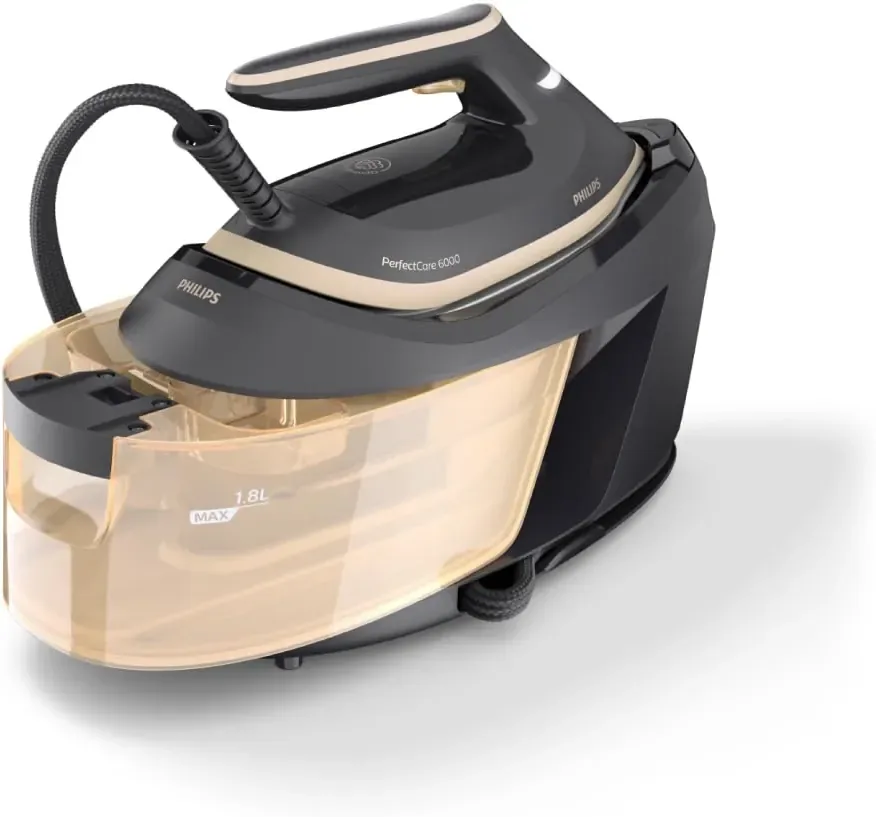
A base with a tank and pump, and an iron connected by a hose. Very fast on big baskets and heavy fabrics, but bulkier. The Philips PerfectCare 6000, our reference model, claims 8 bar, 150 g/min and a boost of up to 600 g.
The handheld steamer
A small appliance held upright that steams a hanging garment. Perfect for touch-ups and travel, limited on heavy fabrics and sharp creases.
The upright garment steamer
A floor-standing base with a pole and hose. Handy for lots of hanging clothes and curtains, with no ironing board. It does not press creases.
| Criterion | Steam generator | Steam iron | Handheld steamer | Upright steamer |
|---|---|---|---|---|
| Ironing board | Yes | Yes | No | No |
| Typical output | 120 to 160 g/min | 30 to 60 g/min | 15 to 25 g/min | 30 g/min and up |
| Big basket | Excellent | Fair | Poor | Fair |
| Heavy fabrics | Excellent | Good | Average | Average |
| Sharp creases | Excellent | Good | Poor | Poor |
| Size | Medium | Small | Very small | Large |
| Travel | No | Possible | Yes | No |
Speed: the real difference
Speed has two parts: getting started and time per item.
For a single item, the iron or steamer wins
For one shirt before you leave, a steam generator’s heat-up, about 2 minutes for the PerfectCare 6000, adds nothing compared with an iron that heats in a minute or a steamer in thirty seconds. The time saved per item does not make up for setting up.
For a basket, the steam generator pulls well ahead
From about ten items, plentiful steam cuts the number of passes and the large tank ends the trips to the tap. On a family basket with sheets and jeans, the time difference becomes clear. That is what a steam generator is for.
| Situation | Fastest appliance |
|---|---|
| One shirt before leaving | Handheld steamer |
| Three shirts on Sunday evening | Steam iron or steam generator |
| A couple’s weekly basket | Steam generator |
| Sheets and duvet covers | Steam generator |
| Hanging curtains | Upright steamer, or steam generator held vertically |
Results, fabric by fabric
| Fabric | Steam generator | Steam iron | Our advice |
|---|---|---|---|
| Fine cotton, poplin | Very good, fast | Very good | Both work; the steam generator is faster on volume |
| Heavy cotton, sheets | Excellent | Fair, several passes | Steam generator |
| Linen | Excellent with the boost | Good on damp fabric | Steam generator |
| Denim, canvas | Excellent inside out | Good | Steam generator |
| Wool | Good, steam without pressing | Good with a pressing cloth | Both, with care |
| Silk, viscose | Good with a single temperature | Delicate, setting to watch | Single-temperature steam generator, or steamer |
| Synthetics | Good inside out | Good inside out | Both |
Our article on ironing linen, jeans and bed sheets details the techniques for difficult fabrics.
Sharp creases and stubborn creases
For stubborn creases, the steam generator has a clear advantage: continuous steam and the boost get through crumpled linen, the knees of jeans and thick collars in one or two passes. An iron gets there too, with more passes and often a spray bottle to dampen the fabric.
For creases you want, such as a trouser crease or sleeve creases on a shirt, both appliances work, because it is the soleplate on the board that presses the crease. The steam generator helps set them faster thanks to plentiful steam, followed by a dry pass.
Delicate fabrics
With a standard iron, the risk comes from the thermostat: too hot and it makes synthetics shiny, scorches viscose or yellows silk. You need to sort your laundry and wait for the soleplate to cool before moving on to delicate items.
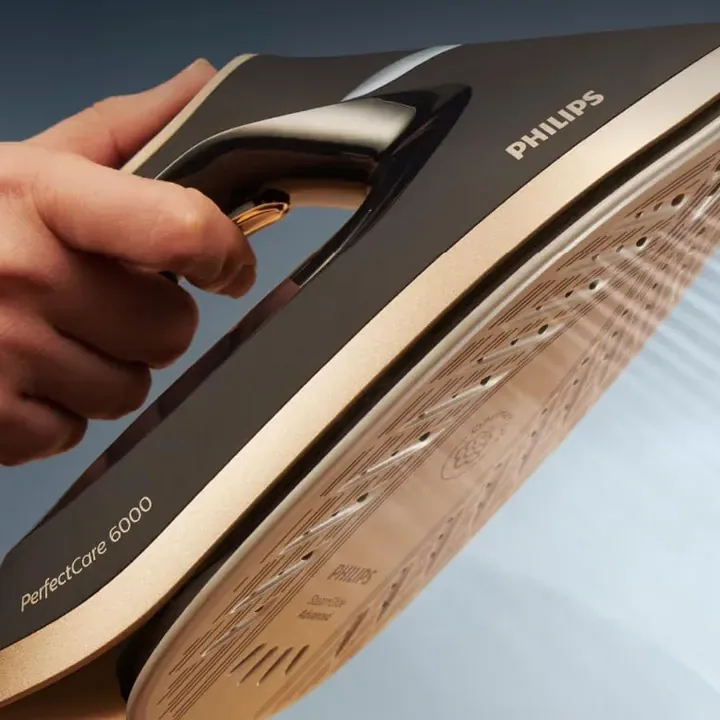
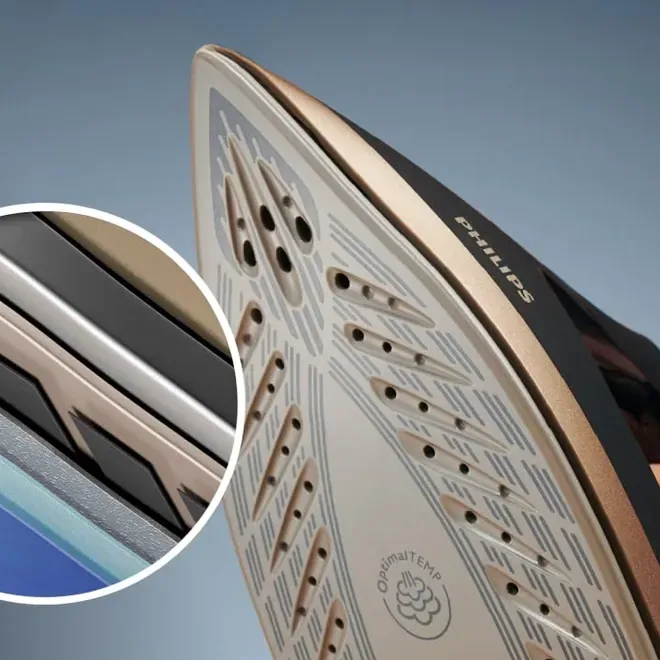
Single-temperature steam generators remove that step. The Philips PerfectCare 6000 uses OptimalTEMP technology, which Philips guarantees will not burn any ironable fabric, even if the iron is left resting on the garment. You can go from a viscose blouse to a cotton sheet without touching a setting. Ironing inside out is still advisable for dark and shiny fabrics.
Comfort, weight and fatigue
A steam iron often weighs 1.2 to 1.6 kg with water, and you hold all of it the whole time. A steam generator’s iron usually weighs 0.8 to 1.3 kg, with no water, since the tank is in the base: steam does most of the work and your wrist tires less. The PerfectCare 6000’s iron weighs 1.2 kg according to Philips.
In return, a steam generator has a hose to manage, which needs to go over the board so it does not drag across the laundry. You get used to it in a session or two.
Size and storage
An iron fits in a drawer. A steam generator needs a shelf: around 37 × 17 × 27 cm for a compact model like the PerfectCare 6000, more for larger models. Either way you need an ironing board, which remains the bulkiest item. If you have no room at all for a board, even a folding one, neither an iron nor a steam generator will suit you: look at an upright steamer instead. Read our article on the compact steam generator iron.
Safety
- A steam iron stands balanced on its heel: it can fall if the cord is pulled.
- A steam generator sits on a stable base; the iron rests on a platform and can often be locked for carrying. It produces pressurised steam: never point it at anyone.
- Both must be kept out of children’s reach and unplugged after use.
Auto shut-off is common on both types. The PerfectCare 6000 has auto shut-off and a carry lock, according to Philips.
Electricity use
The formula is the same for all of them: power in kW × hours × price per kWh. At a reference rate of 27.64p per kWh, the Ofgem price cap for direct debit customers for October to December 2026, and one hour of ironing a week for a year:
| Appliance | Typical power | Annual maximum |
|---|---|---|
| Steam generator | 2400 W | 124.8 kWh, or £34.49 |
| Steam iron | 2400 W | 124.8 kWh, or £34.49 |
| Handheld steamer | 1000 W | 52 kWh, or £14.37 |
These are ceilings, as if the appliance were heating non-stop. At the same power, a steam generator and an iron use the same per hour; the steam generator gets through more laundry in that hour, which can cut the total time for the same basket. Run the numbers with your own figures in our calculator.
Maintenance and lifespan
Limescale is the common enemy. It is one of the main causes of failure in steam appliances, which is why durability tests in laboratories track steam output over time.
- Steam iron: built-in anti-scale system and a self-clean function on many models.
- Steam generator: scale collector, cartridge or guided descaling depending on the model. The PerfectCare 6000 uses the Smart Calc Clean system with a supplied container and a sound and light reminder.
Our guide how to descale a steam generator iron explains the right method.
The overall budget
We do not quote prices, which change often, but the gaps between categories stay much the same. A steam iron generally costs a good deal less than a steam generator. A mid-range compact steam generator sits above it, and large premium steam generators or ironing systems higher still. In every case, allow for a stable board with a cover in good condition.
The right sum is not just the purchase price, it is the time saved each week. For a household that irons for an hour a week, a steam generator that saves a third of the time gives back dozens of hours a year. For a household that irons for ten minutes a week, the benefit is small.
Combinations that work
Steam generator alone
For a household that irons every week and rarely travels. The simplest solution for large volumes.
Steam generator and handheld steamer
The steam generator for the weekend basket, the steamer for Tuesday morning’s shirt and for trips away. The most comfortable combination.
Iron alone
For someone living alone or a couple ironing a little light laundry. Simple and economical.
Upright and handheld steamers
For people with no room for a board and lots of hanging clothes.
Work shirts
Five shirts a week: steam generator or iron? If you iron them all on Sunday, the steam generator saves time, especially with heavy cotton or oxford shirts, and a single temperature means nothing to adjust. If you prefer to iron each day’s shirt in the morning, an iron or steamer is more practical, since a steam generator needs about two minutes to heat up.
A mixed routine works well: all five shirts with the steam generator on Sunday, hung straight away, and a quick pass with the steamer in the morning if one has picked up a crease in the wardrobe. Our guide how to iron a shirt with a steam generator details the method.
Organising your ironing
The weekly session
The week’s laundry in one session, from the finest to the heaviest, with the steam generator. This is where a steam generator gives its best.
Ironing as you go
A few items each evening, with an iron or steamer. Less time in one go, but repeated setting up.
The bare minimum
Laundry dried on hangers, ironing limited to shirts and linen, a steamer for the rest. Workable with a wardrobe that is mostly soft fabrics.
Habits that still apply
- Iron inside out dark fabrics, denim and synthetics to avoid shine.
- Iron damp linen and heavy cotton.
- Use a pressing cloth on wool and delicate fabrics when you have a manual thermostat.
- Hang each item as soon as it is ironed.
- Finish with a pass without steam to dry and set.
What independent tests measure
Consumer organisations such as Which? test irons, steam generators and ironing systems separately, with protocols suited to each. For steam generators, they typically measure steam output, assess crease removal on several fabrics, follow resistance to limescale over extended use, and rate ease of use and safety.
These protocols confirm that irons and steam generators do not compete in the same category: an appliance is compared with its direct rivals. That is also the logic of this comparison: choose the right category first, then the right model.
What about the environment?
Ironing accounts for a small share of a household’s electricity use, but some choices matter. A steam generator that gets through the same basket faster does not use more than an iron of the same power; an eco mode, where available, cuts consumption further. Maintenance matters too: a scaled-up appliance heats less well and does not last as long.
At the end of its life, an electrical appliance goes to a household waste recycling centre, or back to a retailer that offers take-back when you buy a replacement, never in the bin. Before that, consider repair, especially with brands that commit to stocking spare parts for several years.
Iron less, whatever the appliance
- Do not overload the drum: tightly packed laundry creases more.
- Adjust the spin: a gentle spin for shirts limits deep creases.
- Take laundry out as soon as the programme ends and shake each item.
- Dry shirts on hangers.
- Hang sheets out taut, pulling on the seams.
- Fold dry laundry straight away rather than leaving it in a heap.
New or second-hand?
Steam generators are easy to find second-hand, sometimes barely used. The main risk is invisible: limescale built up by the previous owner. Before you buy, ask about the water hardness and how often it was descaled, test the steam on a pale cloth and check the soleplate, which should be neither scratched nor stained. A second-hand steam iron is less worthwhile, as the saving is small. In both cases, buying from a private seller gives you far fewer rights than buying from a trader.
The board, a shared ally
Steam generator or iron, the result also depends on the board. A stable board set at hip height, with a thick, breathable cover, improves comfort as much as results. For a steam generator, check that the rest is wide enough for the base, or have a stable surface alongside. A worn, flattened or torn cover wastes part of the benefit of a good appliance: replacing it is often the cheapest way to improve your ironing.
Ergonomics and health
Ironing puts strain on the back, shoulders and wrists. A few rules apply whatever the appliance: board at hip height, feet slightly apart, regular breaks during long sessions, laundry within reach so you are not constantly bending down. With a steam generator, the iron is often lighter because it carries no water, and steam does part of the work: you press less. Anyone prone to wrist pain should compare iron weights, between 0.8 and 1.3 kg on steam generators.
Noise day to day
A steam iron is almost silent, apart from the hiss of steam. A steam generator’s pump can be heard each time you press the trigger, as a hum or quick clicks. For most households this is not a problem; in a small flat in the evening, it can matter. Buyers of the PerfectCare 6000 find it a little noisier than some models, without it being a nuisance.
Households where more than one person irons
In many homes, several people iron, each with their own habits. One prefers a weekly session, another a quick touch-up in the morning. A single-temperature steam generator has a quiet advantage here: nobody has to wonder which setting to leave the thermostat on, or wait for it to cool after someone else has used it. A handheld steamer kept within reach serves whoever irons at the last minute. This split avoids clashes and gets the best out of each appliance.
If one appliance has to do everything, the steam generator remains the most versatile choice for a household that irons regularly, as long as you accept the two-minute heat-up for one-off touch-ups.
Vertical steaming with a steam generator
Many steam generators, including the PerfectCare 6000 according to Philips, can be used vertically: you hold the iron a few centimetres from a hanging garment and press the trigger without touching the fabric. It is useful for a jacket, a coat, a dress with ruffles or curtains, and saves putting up the board for a bigger touch-up.
This function does not fully replace an upright steamer if you deal with lots of hanging clothes every week, but it easily covers occasional use. Hold the garment by the hanger or the hem, never with your hand in front of the steam, work from top to bottom and let the garment dry on the hanger before wearing it. And the usual rule: never on a garment someone is wearing.
Ironing with children around
A steam generator changes a few things in a home with young children. The base is stable, but the hose and cord can be tempting to pull, and the steam is hot and pressurised. Set up the board where the cord does not cross a walkway, keep the base on its rest or on a table well back from the edge, and never leave the appliance switched on unattended, even for a moment.
After the session, unplug the steam generator and let it cool in a spot children cannot reach before storing it. The carry lock helps when you move it, but it is not a child lock. A handheld steamer, being lighter, is easier to put out of reach quickly, which is another reason to keep one for quick touch-ups. These precautions apply just as much to a standard steam iron, which can tip over if its cord is pulled.
Try before you decide
If you are torn, compare your current ironing time with what a steam generator promises: time a usual session with your iron and note the number of items and the fabrics. If the session regularly goes past three quarters of an hour, or heavy fabrics have you going over the same spot again and again, a steam generator will make a clear difference. If you iron for a quarter of an hour a week, the gain will be small. The 14-day cancellation period that generally applies to online purchases also lets you try an appliance at home, under the conditions set by the retailer.
The decision tree
- Do you iron more than twenty items a week? Yes: a high-output steam generator. No: next question.
- Do you have lots of linen, denim or sheets? Yes: a steam generator, compact if space is tight. No: next question.
- Do you iron more than ten items a week? Yes: a steam generator. No: next question.
- Do you mainly iron at the last minute or while travelling? Yes: a handheld steamer. No: a steam iron.
Five common myths
- “Steam generators are for big families.” Compact models also suit couples who iron every week.
- “A steam generator uses far more electricity.” At the same power, no; and it irons faster.
- “A steam generator damages delicate fabrics.” Not at the right temperature; single-temperature models are guaranteed by their makers not to burn fabrics.
- “An iron is always enough.” For small amounts, yes; for a big basket of heavy fabrics, the time difference is clear.
- “A steamer replaces everything.” No: it does not press creases and struggles with heavy fabrics.
Three households, three choices
Emma, lives alone, works from home part of the week
A few viscose blouses, two pairs of trousers, not many sheets. A good steam iron is enough; a handheld steamer can help on office days.
Sam and Priya, two children
Sheets, jeans, school uniforms, shirts: twenty-five items a week. A high-output steam generator is the obvious choice; a compact one like the Philips PerfectCare 6000 works if space is tight. A handheld steamer covers trips away.
Graham, retired, a linen enthusiast
Linen shirts all summer, trousers with a crease. A steam generator with a boost makes linen far easier to iron; an iron is still possible, with more time.
These profiles show that the question is never “what is the best appliance?” but “which appliance fits my laundry and my habits?”.
Look at your wardrobe before choosing
A simple exercise helps you decide: open your wardrobe and sort ten items you wear often by their care label and fabric. Lots of heavy cotton, linen, denim and sheets point towards a steam generator; lots of viscose, polyester and jersey point towards an iron, or even a steamer. Then count how many of those items you iron each week. Those two pieces of information, fabrics and volume, are worth more than any product listing for choosing the appliance that will genuinely save you time.
Frequently asked questions
Does a steam generator replace an iron?
Yes, a steam generator does everything an iron does, faster on large volumes. It is just less practical for a one-off touch-up and takes up more space.
Does a steam generator really iron faster?
On a basket of about ten items or more, yes, thanks to steam output several times higher and a large tank. On a single item, no.
Steam generator or iron for shirts?
Both work. The steam generator is faster if you iron several shirts in one go; the iron is more practical for a single shirt.
Does a steam generator use more electricity than an iron?
At the same power and for the same time, no. Because it irons faster, it can even cut the total time.
Should you keep your iron when you buy a steam generator?
There is no need. A handheld steamer is a better companion for touch-ups and travel.
Which steam generator for a small home?
A compact model such as the PerfectCare 6000 (36.8 × 16.8 × 26.9 cm), with a folding board. See our article on the compact steam generator iron.
Is a steam generator more dangerous?
It produces pressurised steam, but the base is stable and the iron often locks for carrying. The safety rules are the same: out of children’s reach, unplug after use.
Can you steam vertically with a steam generator?
Yes with most models, including the PerfectCare 6000 according to Philips, for a jacket or curtains. Never on a garment being worn.
Crisp laundry, in less time.
8 bar · 150 g/min · 600 g steam boost · 2400 W · 1.8 L tank. The price changes often on Amazon: check it, along with the seller, the PSG6064/80 model number, the UK plug and the returns policy, before you order.
Check the price on AmazonAffiliate link · new tab